 Caroline Arbor
You will understand the precise relationship between light intensity, ambient temperature, and stem elongation in young tomato and pepper starts. With these adjustments, your seedlings will develop dense nodes and sturdy main stalks before garden planting.
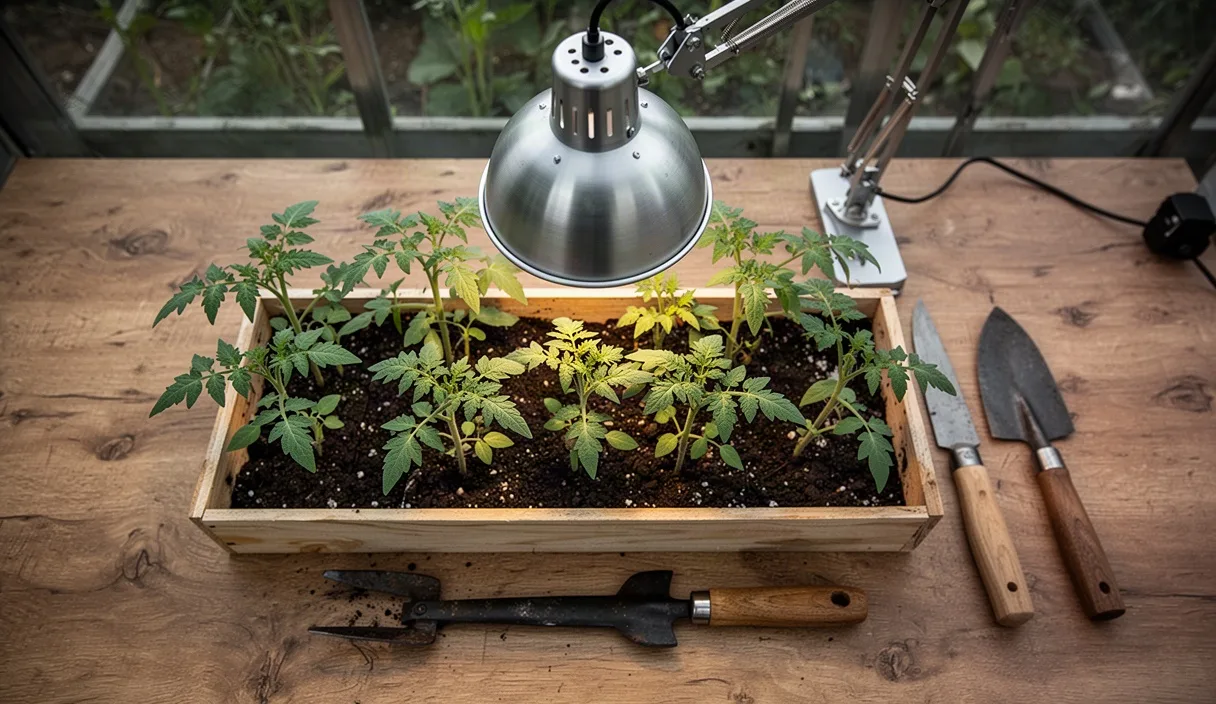
- Position supplemental lamps within five to seven centimeters of the seedling canopy to avoid stem stretching.
- Lower night temperatures by four degrees to slow vertical growth and encourage root division.
- Use a gentle oscillating breeze to trigger mechanical stem thickening in young transplants.
The propagation of garden plants from seed indoors requires close observation and deliberate management of the growing environment. Among the challenges encountered during the early weeks of propagation, excessive stem elongation, frequently termed legginess, remains one of the most frustrating. Young seedlings that stretch rapidly toward an insufficient light source develop slender, fragile stems incapable of supporting the weight of their true leaves. When transplanted into garden soil or larger containers, these frail specimens often collapse, succumb to fungal infection, or suffer severe stunting from which they rarely recover their full vigor.
Artificial lighting provides an effective remedy, yet merely placing a fixture above a propagation flat does not guarantee stocky, resilient growth. The gardener must coordinate photon volume, operational duration, ambient temperature, and mechanical stimulation. By understanding how seedling physiology responds to these environmental cues, one may establish a structured propagation regimen that yields firm stems, healthy root systems, and durable plants ready for the outdoor garden.
The Physiology of Stem Elongation in Low Light
Seedlings possess specialized photoreceptor proteins, notably phytochromes and cryptochromes, which regulate stem elongation through a process known as shade avoidance. Phytochromes respond specifically to the ratio of red light (approximately 660 nanometers) to far-red light (approximately 730 nanometers). In full, unfiltered daylight, this ratio is balanced. When light levels diminish, or when light filters through a dense canopy, the proportion of far-red light rises. The plant interprets this shift as competition from neighboring foliage, triggering the synthesis of auxins, a class of growth hormones that stimulate cell wall loosening and rapid vertical extension in the hypocotyl.
Cryptochromes, which perceive blue light wavelengths between 400 and 500 nanometers, serve an opposing regulatory function. Adequate blue light acts as a natural brake on cellular elongation. It instructs the seedling that it has reached unobstructed light, thereby arresting stem stretch and directing cellular energy toward the development of true leaves, root branching, and the deposition of structural lignin within vascular bundles. When seedlings grow beneath artificial fixtures deficient in blue photons, or where the total luminous flux is inadequate, hypocotyl expansion continues unabated.
This hormonal response operates rapidly. Within twenty-four to forty-eight hours of emergence, a seedling deprived of sufficient light intensity can double its vertical height without adding cellular mass. The resulting cell walls are abnormally thin and contain low concentrations of cellulose. Such tissue provides little mechanical resistance against air movement, watering, or the natural burden of cotyledon expansion.
Calculating Distance and Duration for Domestic Light Fixtures
The intensity of light received by a plant decreases inversely with the square of the distance from the fixture. Domestic growers often employ fluorescent tubes or modern light-emitting diode (LED) arrays. Because these domestic units lack the intense output of commercial high-pressure sodium lamps, they must be situated considerably closer to the canopy than many beginners anticipate. Fluorescent T5 high-output fixtures should generally sit between two and four inches above the emerging seedlings. Standard white or broad-spectrum LED shop lights, which generate modest heat, perform best between three and six inches above the foliage.
Suspension systems must allow for daily or weekly adjustment. As seedlings grow, the fixtures must be raised gradually to maintain that critical distance. Permitting the canopy to advance to within one inch of standard fluorescent tubes risks thermal scorching, whereas allowing the fixtures to linger eight to twelve inches above young plants drastically reduces photon density, prompting immediate stem elongation.
| Fixture Type | Recommended Clearance | Daily Operating Duration | Primary Consideration |
|---|---|---|---|
| T5 High-Output Fluorescent | 2 to 4 inches | 14 to 16 hours | Monitor surface heat on delicate cotyledons. |
| Standard LED Shop Light (Broad Spectrum) | 3 to 6 inches | 14 to 16 hours | Ensure uniform coverage across tray margins. |
| High-Intensity Horticultural LED | 10 to 14 inches | 12 to 14 hours | Follow manufacturer ratings to prevent light stress. |
Duration must balance the plant's photosynthetic needs against its requirement for a dark period. Supplying continuous light for twenty-four hours disrupts natural circadian rhythms and can provoke chlorosis or metabolic fatigue in species such as Solanaceae (tomatoes, peppers, and eggplants). An operational schedule of fourteen to sixteen hours of light, controlled by a reliable mechanical or digital timer, delivers ample daily light integral while preserving eight to ten hours of uninterrupted darkness for respiration and internal carbohydrate distribution.
Managing Day and Night Temperature Differentials
While light intensity dictates the signal for stem extension, ambient temperature governs the rate of enzymatic activity and cellular division. A common oversight in home propagation involves running heating mats continuously after germination has occurred. Warm root zones accelerate cell expansion. If high root-zone and ambient temperatures coincide with modest light levels, stem elongation proceeds at an extreme pace.
Commercial horticulturists utilize a technique known as DIF, which refers to the mathematical difference between day and night temperatures. Plant stems elongate more readily when day temperatures exceed night temperatures (positive DIF). Conversely, when night temperatures match or slightly exceed daytime temperatures (zero or negative DIF), stem elongation is naturally suppressed without the application of chemical growth regulators.
To implement this principle within a home setting, adopt the following temperature routine:
- Remove propagation trays from bottom heat mats immediately upon the appearance of the first seedling loop or cotyledon.
- Maintain daytime ambient conditions between 65 and 70 degrees Fahrenheit while the fixtures are illuminated.
- Allow ambient temperatures to decline to 58 to 62 degrees Fahrenheit during the dark period, or maintain a constant 64 degrees Fahrenheit throughout the entire cycle.
- Provide supplementary room heating only if ambient temperatures fall below 52 degrees Fahrenheit, which might cause physiological chilling in warm-season vegetables.
Lowering the dark-period temperature reduces cellular respiration, conserving the sugars synthesized during the day. These conserved carbohydrates are then directed into leaf tissue and lateral root growth rather than wasteful hypocotyl stretching.
Air Circulation as a Tool for Sturdier Stems
In a protected indoor environment, seedlings encounter none of the mechanical resistance supplied by natural breezes. In nature, wind causes microscopic flexing in the stems, a stimulus that initiates a physiological adaptation known as thigmomorphogenesis. When a stem bends under mechanical force, the plant produces ethylene, which slows vertical growth and encourages radial thickening through the deposition of extra cellulose and lignin.
A small, oscillating electric fan positioned several feet from the seedling benches provides this necessary mechanical stimulation. The airflow should be gentle; the foliage should tremble lightly rather than bend severely beneath a direct blast. A harsh or direct airstream risks desiccating fragile leaf margins and chilling the moist potting substrate excessively.
Operate the circulation fan for two to three intervals of thirty to forty-five minutes each day during the daylight cycle. Alternatively, growers may brush the palms of their clean hands across the tops of the seedlings once or twice daily, making approximately twenty gentle passes over the tray. Research demonstrates that this simple physical interaction reduces final stem height by twenty to thirty percent while increasing stem diameter and root mass proportionally.
Corrective Measures for Stems That Have Already Stretched
When environmental controls fail and seedlings become noticeably drawn, immediate intervention can salvage a portion of the crop. The corrective approach depends entirely on the anatomical capacity of the species to produce adventitious roots along its buried stem tissue.
Members of the Solanaceae family, notably tomatoes and to a lesser extent peppers, form adventitious roots freely from hypocotyl tissue. When potting on stretched tomato seedlings from multi-cell trays into individual three-inch containers:
- Moisten the seedling flat thoroughly one hour before repotting to minimize root breakage.
- Carefully lift the seedling by its root plug or cotyledons, avoiding any pressure on the delicate hypocotyl.
- Excavate a deep hole in the new container, or place the seedling at an angle along a shallow trench in the potting mix.
- Bury the stem down to within a half-inch of the lowest healthy cotyledons or true leaves.
- Firm the potting medium gently around the stem to eliminate air pockets, and water immediately to settle the soil.
Non-solanaceous crops, including brassicas (cabbage, kale, and broccoli), can tolerate shallow burying up to the base of the cotyledons, provided the potting mix is sterile and free-draining. However, species with taproots or hollow stems, such as cucurbits (cucumbers, squash) and alliums (onions, leeks), should never be buried deeply. Submerging their stems below the soil line almost invariably leads to collar rot caused by fungal pathogens such as Rhizoctonia or Pythium.
For crops that cannot be deeply buried, adjust the light fixture downward immediately, lower room temperatures, and insert a slender wooden skewer beside the plant, securing the stem loosely with soft cotton twine until secondary thickening stabilizes the base.
Common Mistakes in Seedling Management
Careful growers frequently introduce errors despite sound intentions. The following oversights account for the majority of leggy propagation trays:
- Relying on sunny windowsills: Solar radiation passing through modern double-pane glass loses substantial intensity, and early spring days often feature short day lengths and cloudy conditions. Seedlings placed on sills inevitably lean toward the glass, developing asymmetric, weak stems.
- Delaying light exposure after germination: Seedlings expend energy reserves rapidly once the seed coat splits. Waiting until all seeds in a tray have emerged before turning on fixtures guarantees that the earliest germinants will stretch within hours.
- Overwatering accompanied by high heat: Maintaining saturated potting soil in warm rooms produces rapid, watery cell division. Let the upper surface of the medium dry slightly between light waterings once true leaves emerge.
- Using unshielded incandescent bulbs: Incandescent filaments emit high levels of heat and far-red light while providing negligible usable blue spectrum, creating the precise physiological conditions that induce severe stem stretching.
Practical Next Steps for the Propagation Bench
To protect upcoming sowings from elongation, begin with a structured assessment of the growing station. Inspect your light suspension hardware to ensure that chains or ratchets permit swift height adjustments down to two inches from the bench surface. Position an independent digital thermometer and hygrometer at canopy level rather than on the wall several feet away, as temperature gradients near light ballasts can be substantial.
Next, install a seven-day or twenty-four-hour timer to regulate your lighting equipment automatically, setting it for fifteen hours of continuous daily illumination. When seeds begin to break the soil surface, immediately remove humidity domes and turn off heating cables or mats. Introduce a mild oscillating breeze during daytime hours, and maintain a written log of sowing dates, light heights, and ambient room temperatures. These systematic adjustments transform indoor propagation from an unpredictable trial into a dependable source of robust garden transplants.
This material serves educational purposes only; consult a local certified extension specialist or soil testing laboratory for site-specific agricultural decisions. Disclaimer

Further Reading
-
 Seed Propagation and Seedlings 10 min read
A Guide to Seed Scarification and Cold Stratification
You will master the physical and thermal treatments required to break seed dormancy in difficult perennials and woody fruit varieties. You will confidently awaken seeds that otherwise refuse to germinate under ordinary indoor conditions.
-
 Seed Propagation and Seedlings 10 min read
Choosing Starter Soil: Commercial Mixes Versus Home Blends
You will evaluate the drainage, porosity, and nutrient content of commercial seed media alongside custom blended substrates. You will be prepared to mix reliable potting soil that supports early root formation without pathogen pressure.