 Caroline Arbor
You will balance carbon and nitrogen inputs to manage a tidy, productive compost pile that breaks down kitchen and garden trimmings cleanly. You will generate sweet-smelling, nutrient-dense humus for your beds within a single growing season.
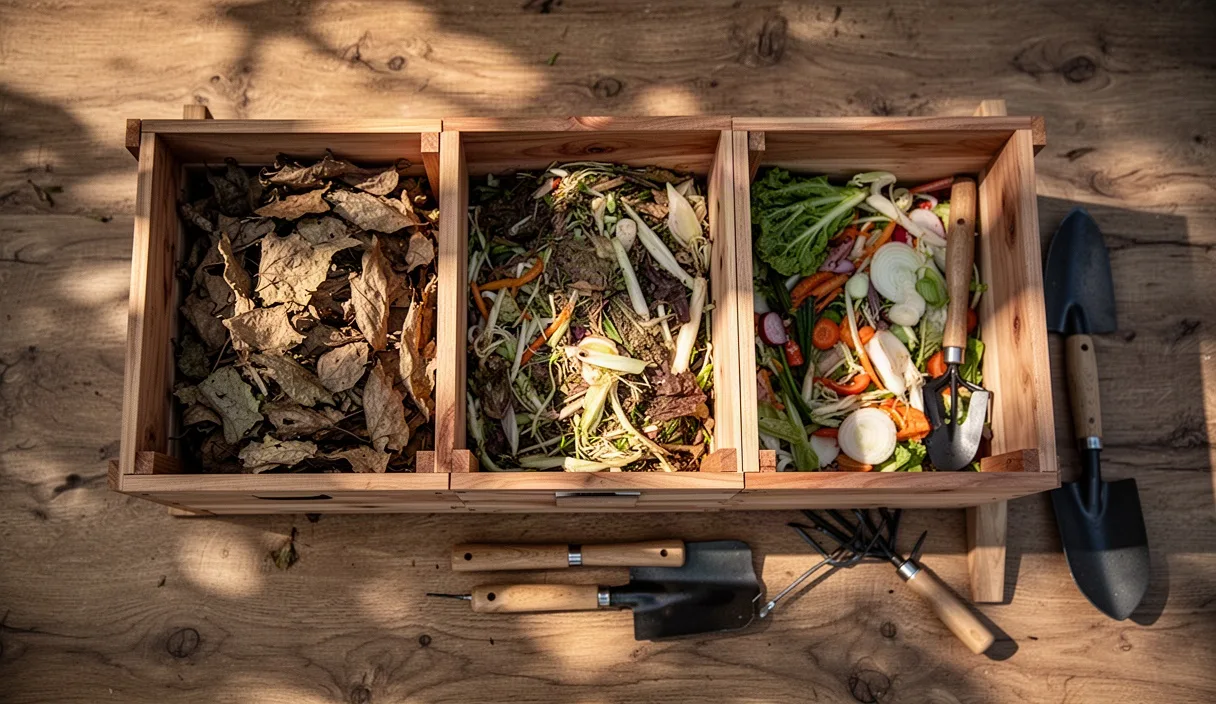
- A volumetric ratio of three parts brown matter to one part green matter sustains rapid decomposition.
- Regular pile aerations supply the oxygen necessary to suppress foul anaerobic odors.
- Moisture levels should match that of a wrung-out natural sponge across the interior.
The creation of fertile soil through controlled biological decay represents one of the most dependable disciplines in horticultural practice. An active garden compost heap is neither an untended rubbish pile nor an inert repository for kitchen scraps; it is a living, thermophilic ecosystem engineered to transform cellulose, lignin, and raw organic proteins into stable, dark humus. When managed with deliberation, this process generates substantial biological heat, eliminates common weed seeds, and neutralizes pathogens that might otherwise persist in topsoil.
To establish such a system requires an understanding of microbiological dynamics, moisture control, and structural porosity. Gardeners who approach composting as an exact chemical and biological craft find that it yields a reliable conditioner capable of revitalizing tired beds, improving friability, and supporting the indigenous mycorrhizal networks of the estate garden. The following directions detail the assembly, maintenance, and finishing of an active compost mass.
The Biological Mechanics of Aerobic Decomposition
Aerobic composting relies upon an ecological succession of microorganisms, predominantly bacteria, actinomycetes, and fungi. During the initial hours after a heap is constructed, mesophilic bacteria proliferate rapidly. These organisms thrive at moderate temperatures between 68 and 113 degrees Fahrenheit, consuming readily available sugars and starches. As their cellular respiration accelerates, they release thermal energy that cannot readily dissipate through the insulating bulk of the pile, causing internal temperatures to climb.
When the core exceeds 113 degrees Fahrenheit, thermophilic bacteria, notably members of the genus Bacillus, assume dominance. These heat-tolerant organisms break down more complex proteins, fats, and hemicelluloses. Temperatures between 131 and 145 degrees Fahrenheit represent the peak of thermophilic activity. Within this bracket, the thermal death point of human and plant pathogens is achieved, provided such heat is maintained uniformly for several days. However, should the heap exceed 158 degrees Fahrenheit, beneficial microbial populations suffer severe mortality, leaving the pile biologically depressed and slow to recover.
As the primary feedstocks are consumed, the heat output subsides. Mesophilic organisms, accompanied by actinomycetes and specialized fungi, recolonize the outer margins and gradually penetrate the core. Actinomycetes impart the characteristic earth-like scent to mature compost and are responsible for degrading resilient lignins and chitins. In the final phase, macroorganisms such as nematodes, potworms, and ground beetles enter the cooler substrate, shredding coarse fibers and depositing enriched casts that stabilize the final product.
Balancing Carbon Rich Materials with Nitrogen Sources
The engine of the compost pile is governed by the carbon-to-nitrogen ratio, conventionally designated as the C:N ratio. Soil microorganisms require roughly twenty-five to thirty parts of carbon for energy and cellular growth to every single part of nitrogen utilized for protein synthesis. If the gross ratio of the pile exceeds forty to one, biological activity stalls due to nitrogen starvation, and decomposition proceeds at an imperceptible pace. Conversely, an excess of nitrogen, marked by a ratio below twenty to one, leads to the volatilization of surplus nitrogen into ammonia gas, generating sharp odors and nitrogen loss.
Garden materials are categorized into carbonaceous brown matter and nitrogenous green matter. Brown items contribute physical structure, air pockets, and sustained fuel, whereas green inputs provide the immediate moisture and amino acids necessary to drive microbial reproduction. Achieving an overall volumetric proportion of approximately two or three parts coarse brown material to one part dense green material generally produces a favorable biochemical equilibrium.
| Feedstock Material | Approximate C:N Ratio | Functional Contribution | Handling Recommendation |
|---|---|---|---|
| Hardwood Sawdust (Dry) | 400:1 | Slow-release carbon, high absorbency | Incorporate in thin, dusting layers only |
| Autumn Leaves (Dry, Shredded) | 55:1 | Stable carbon bulk, moderate aeration | Shred thoroughly to prevent matted layers |
| Cereal Straw (Wheat or Barley) | 75:1 | Structural porosity, resistant carbon | Chop to lengths of three to four inches |
| Fresh Lawn Clippings | 19:1 | Rapidly available nitrogen, moisture | Disperse evenly; never pack in deep slabs |
| Kitchen Vegetable Waste | 16:1 | High nitrogen, enzymatic moisture | Bury beneath five inches of carbonaceous matter |
| Well-Rotted Poultry Manure | 12:1 | Potent biological starter, mineral salts | Use sparingly as an activator across layers |
It is prudent to reject certain materials entirely. Weeds with active seed heads, invasive rhizomatous grasses like bindweed and couch grass, diseased tomato foliage carrying late blight, and the waste of carnivorous domestic animals must not enter an estate heap. While industrial facilities can manage these inputs, a garden heap rarely achieves the perfectly uniform heat required to guarantee their complete destruction.
Regulating Internal Moisture and Oxygen Levels
Microbial life exists entirely within thin water films that coat the surfaces of organic particles. Consequently, the internal moisture of the pile must be maintained between forty-five and sixty-two percent of total weight. If moisture drops below forty percent, biological respiration ceases, and the organic matter enters a state of dry preservation. If moisture surpasses sixty-five percent, water displaces oxygen in the interstitial voids, precipitating anaerobic conditions that generate noxious odors, toxic sulfides, and acidic putrefaction.
The moisture level can be evaluated using a straightforward tactile test. Don a clean garden glove, reach toward the center of the mass, extract a generous handful of material, and squeeze it firmly:
- If water flows freely from between the fingers, the mass is waterlogged and requires immediate restructuring with dry, coarse straw or wood shavings.
- If the material crumbles apart upon opening the hand, revealing dusty surfaces, it is dry and must be irrigated with a fine spray as it is turned.
- If the palm remains damp and only two or three drops of moisture appear under firm pressure, the water content is ideal.
Aerobic decomposition demands an uninterrupted supply of oxygen. Microorganisms consume the gas rapidly, depleting interior pockets within forty-eight to seventy-two hours of heap construction. To maintain an internal oxygen concentration above ten percent, structural bulk must be designed into the pile from the outset. Incorporating rigid stalks, coarse sunflower stems, and wood fragments measuring two to three inches creates structural channels. These conduits permit atmospheric air to enter the lower flanks of the heap through natural thermal convection, drawing cooler air upward as heat rises through the center.
Monitoring Temperature Cycles and When to Turn the Mass
Careful temperature tracking removes guesswork from heap management. An industrial compost thermometer, fitted with a stainless steel probe measuring twenty to thirty-six inches, should be inserted into the center of the pile daily during the active cycle. The readings should be recorded in a garden logbook to plot the thermal trajectory.
The thermal sequence dictates the correct schedule for mechanical turning. The process follows a distinct rhythm:
- Initial Ascent: Within thirty-six hours of assembly, the core temperature typically climbs past 105 degrees Fahrenheit. Intervention is unnecessary during this period; allow the thermophiles to multiply undisturbed.
- Sanitization Threshold: The core reaches 131 to 145 degrees Fahrenheit. Maintain this temperature for a minimum of three consecutive days. During this window, pathogen suppression and weed seed mortality occur.
- First Turning Intervention: As the core begins to drift downward, dropping below 120 degrees Fahrenheit, the mass should be turned. Peeling the outer eight inches of dry, unheated material aside, shovel the hot inner core to the outside of the new heap, placing the former outer crust in the warm interior.
- Secondary Heat Spike: Turning reintroduces oxygen and restructures food reserves. The pile will generally rebound to 130 degrees Fahrenheit within twenty-four hours, though this subsequent peak is brief, lasting two to four days.
- Subsequent Aerations: Repeat the turning procedure whenever internal temperatures plateau below 110 degrees Fahrenheit, which usually happens two or three times over an eight-week span.
Turning serves three clear objectives: it restores depleted oxygen, breaks up anaerobic clusters, and redistributes uncomposted perimeter waste to the thermophilic center. One should avoid excessive turning; agitating a heap daily vents valuable heat and tears fragile fungal hyphae before they can break down complex structural carbons.
Screening and Curing Finished Humus for Bed Application
Once the mass fails to reheat following a thorough turning and irrigation, it enters the curing phase. At this juncture, the compost remains biologically unstable despite its dark appearance. Intermediate organic acids, which can impede plant root development and inhibit seed germination, are still present. The pile must be allowed to rest undisturbed for four to eight weeks in a cool, shaded environment. During curing, earthworms and fungal colonies complete the transformation, stabilizing volatile humic acids.
Curing is complete when the material assumes a uniform, chocolate-brown tone, possesses the aroma of woodland soil, and maintains ambient air temperature regardless of moisture adjustments. At this point, the raw compost should be passed through a simple screening frame constructed of rot-resistant lumber and half-inch galvanized hardware mesh. Suspend or angle this frame over a garden cart and toss the material against the screen with a spade.
Screening divides the batch into two valuable garden amendments:
- Fine Sifted Fraction: The loose material that passes through the half-inch mesh is ready for immediate garden use. It may be dressed across vegetable beds at a depth of one-half to one inch, scratched into perennial borders, or incorporated into potting mixtures for nursery stock.
- Oversized Residue (Tails): The coarse fragments caught by the wire, such as small twigs, partially softened walnut shells, and uncomposted bark chunks, are biological gold. Imbued with active fungal cultures, they should be used as inoculant for the base of the subsequent heap, where they will supply structure and microflora.
Common Composting Missteps
Even seasoned horticulturists occasionally encounter problems in the heap. The following table identifies common system failures, their causes, and the corrective actions needed to restore aerobic health.
| Observed Symptom | Primary Mechanism | Corrective Measure |
|---|---|---|
| Strong odor of ammonia | Excessive nitrogenous green matter, insufficient structural carbon | Turn the heap immediately, layering dry straw or chopped leaves throughout |
| Sour, putrid odor resembling sewage | Anaerobic conditions caused by excess water and compacted air voids | Tear down the pile; incorporate dry wood chips to establish drainage; shield from rain |
| Heap remains stone cold after seven days | Moisture deficit, low nitrogen, or inadequate pile volume | Confirm minimum dimensions of three feet cubed; moisten with water and poultry manure |
| Decomposition occurs only in a tiny core | Pile volume is too small to provide insulation from ambient air | Expand heap dimensions to four feet cubed to retain thermal energy |
| Heavy colonization by ants or sowbugs | Heap is overly dry and lingering indefinitely in mesophilic phase | Turn the pile thoroughly while applying a steady water spray to the center |
Practical Steps for the Garden Year
To establish an active composting system, begin by constructing a stable enclosure. A system composed of three adjacent wooden bays, each measuring three feet wide, three feet deep, and three feet tall, offers the ideal structural framework. One bay receives fresh deposits, the second hosts the thermophilic cooking heap, and the third accommodates the curing mass. Unfinished slatted pine or cedar fencing allows natural airflow through the sides while containing the weight.
Procure the required equipment: an accurate dial compost thermometer with an extended probe, a heavy five-tine manure fork, and a screening frame built with half-inch hardware cloth. Stockpile carbon materials systematically. Whenever autumn leaves fall, run a rotary mower over them to reduce their surface area, then bag or bin them in a dry place. Having an abundance of brown material on hand guarantees you can balance surges of rich, moisture-laden greens from kitchen harvests or seasonal garden clearances.
For complex soil problems, suspected soil contamination from past industrial uses, or persistent fungal blights that resist cultural controls, consult an accredited agronomist or your local university cooperative extension office. For the standard soil enhancement of domestic beds, adherence to these principles of biological volume, moisture control, and thermal cycles will reliably yield healthy humus year after year.
This material serves educational purposes only; consult a local certified extension specialist or soil testing laboratory for site-specific agricultural decisions. Disclaimer

Further Reading
-
 Soil Management and Composting 10 min read
Interpreting Laboratory Soil Reports for Kitchen Gardens
You will read soil test parameters including pH, cation exchange capacity, and primary macronutrients without confusion. You will apply only the specific organic amendments your plot requires, avoiding harmful fertilizer excesses.
-
 Soil Management and Composting 10 min read
Cover Crops for the Domestic Raised Bed
You will incorporate autumn and spring cover crops to protect bare raised bed soil from erosion, compaction, and nutrient leaching. You will utilize green manures to fix atmospheric nitrogen and enrich bed tilth naturally.