 Caroline Arbor
You will distinguish between primocanes and floricanes across raspberries and blackberries to carry out confident early spring cuts. You will establish open, airy bushes that resist fungal mildew and produce accessible summer fruit.
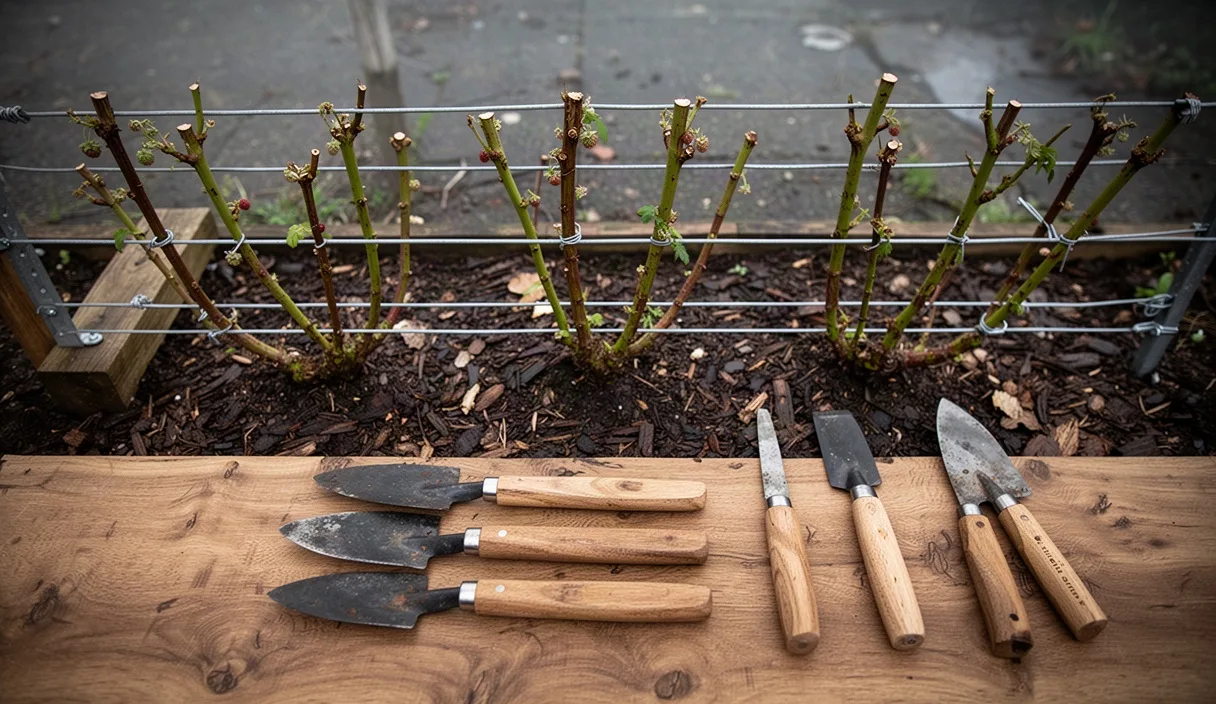
- Removing exhausted spent floricanes immediately after fruiting concentrates energy into new wood.
- Thinning summer canes to four or five per crown improves airflow and fruit size.
- Making clean cuts flush with the root crown suppresses opportunistic cane blight.
The establishment of small fruit plantings requires both patience and a methodical hand. In the first two seasons following installation, bush and cane berries direct significant energy into root development and vegetative architecture. Without disciplined structural intervention during these formative years, brambles and ribes species readily develop into tangled thickets. Such unchecked growth invites fungal pathogens, complicates the summer harvest, and shortens the productive lifespan of the crown.
Formative pruning serves a purpose distinct from the maintenance pruning applied to mature plantings. In the early stages, the grower does not seek to maximize crop yield, but rather to foster strong framework stems, establish renewal lanes, and orient the plants along supportive trellising. By setting appropriate structural habits from the initial planting season, one ensures reliable yields of high quality fruit and preserves the vigor of the stand for many years.
The Two-Year Biological Lifecycle of Cane Fruit
To prune cane berries with accuracy, one must first comprehend the biennial nature of their aboveground growth. Brambles, which encompass both raspberries and blackberries of the genus Rubus, operate from perennial crowns and root systems that generate biennial shoots. Stems arising in the current growing season are termed primocanes. These vegetative canes generally possess green bark, flexible wood, and vigorous foliage designed to fuel root expansion and crown development.
In the second season, these same stems become floricanes. Floricanes take on a woody, weathered appearance, developing lateral branchlets that bear blossoms and subsequent fruit. Once a floricane completes its fruiting cycle in midsummer, its biological imperative is finished, and the cane enters senescence. It gradually dies back to the ground while a fresh cohort of primocanes emerges from the crown beneath it.
| Cane Type | Bark Character | Primary Function | Pruning Action |
|---|---|---|---|
| Primocane | Green, succulent, pliable | Carbohydrate capture, structural framework | Tip according to growth habit; preserve strong specimens |
| Floricane | Woody, brown, peeling outer layer | Flowering and fruit production | Remove entirely to soil line immediately after harvest |
Certain cultivars depart slightly from this classic biennial sequence. Autumn-bearing varieties produce flowers and fruit upon the upper third of their primocanes during late summer of their first year. If retained over the winter, the lower portions of these same canes will fruit again the following summer as floricanes. Distinguishing between purely summer-bearing selections and dual-cropping cultivars remains fundamental before making any structural cuts.
Essential Tools and Sanitizing Cuts for Brambles
Clean, decisive cuts permit woody tissue to callus rapidly without inviting botrytis or spur blight. Bypass pruners, which utilize a single sharpened blade sweeping past a hooked counter-blade, are the proper instrument for green and one-year-old stems. Anvil pruners must be avoided, as their crushing action fractures tender cane walls, leaving splintered openings that invite pathogen entry. For thick, two-year-old floricanes and old crown wood, a narrow-bladed bypass lopper offers necessary leverage without disturbing adjacent shoots.
Disease transmission often occurs via contaminated blades, particularly when moving between older domestic plantings and newly planted nursery stock. Pruning tools should be disinfected periodically throughout the process. A solution of 70 percent isopropyl alcohol applied via a spray bottle or clean cloth serves well, as it does not corrode carbon steel blades. Alternatively, a dilute solution of one part household chlorine bleach to nine parts water provides reliable sanitation, though blades must be rinsed with clear water and dried afterward to prevent pitting.
- Making the cut: Position the cutting blade close to the main stem or crown, angling the cut at roughly 45 degrees.
- Bud clearance: When shortening canes, make the cut approximately one-quarter of an inch above an outward-facing bud. Cutting too close damages the vascular supply to the node, whereas cutting too far leaves a dead stub prone to fungal rot.
- Sanitation cadence: Disinfect blades between separate cultivars, and immediately after severing any cane exhibiting dark lesions, split bark, or insect galls.
It is prudent to maintain a sharpening stone in the field. A dull bypass blade tends to pinch rather than slice, tearing the outer vascular layer known as the phloem. Clean edges heal smoothly under natural suberization processes, whereas jagged tears remain wet and vulnerable to microbial colonization.
Pruning Raspberry Cultivars by Fruiting Schedule
Raspberries fall into two broad pruning categories determined by their fruiting schedules: summer-bearing varieties and autumn-bearing varieties. Summer-bearing cultivars, including Tulameen and Boyne, fruit exclusively on overwintered floricanes. During the first growing season of a new planting, all canes must be permitted to grow without tip removal, thereby encouraging maximum linear growth and root establishment. In the late winter of the second year, thin the dormant canes to leave between four and six of the stoutest shoots per linear foot of row. Shorten these canes slightly, removing only weak tip growth down to firm, pencil-thick wood.
Following the summer harvest, these spent canes will begin to yellow. Remove them at the soil surface promptly, allowing the newly emerging primocanes unobstructed access to ambient sunlight. Do not leave tall stubs at the base, as dead wood harbors anthracnose spores over the subsequent winter.
Autumn-bearing cultivars, such as Heritage and Autumn Bliss, offer two distinct pruning pathways depending on the objectives of the grower:
- Single-crop management: For maximum autumn yield and simplified maintenance, mow or hand-prune all canes flush with the ground in late winter while the plant remains dormant. This forces the crown to throw up a dense, uniform stand of primocanes in spring, which will bear fruit on their upper sections from late August until early frost.
- Double-crop management: If an early summer harvest is also desired, selectively prune the previous year's canes in early spring. Remove only the spent, dead tips that bore fruit the preceding autumn, leaving the viable lower wood intact. These lower sections will develop fruiting spurs in June, while new primocanes rise around them for the subsequent autumn harvest. This method yields two moderate pickings rather than one concentrated crop.
Black raspberries and purple hybrids require a specialized technique known as summer tipping. Because their canes grow with extreme vigor and tend to trail, the grower must pinch out the terminal three inches of primocanes when they attain a height of 28 to 32 inches. This pinch interrupts apical dominance, forcing the cane to throw stout lateral branches. In the late winter, shorten these lateral branches to twelve to fifteen inches in length, which produces fruit within easy reach and prevents canes from snapping under crop weight.
Trellising and Spacing for Optimal Interior Airflow
Damp, still air within a berry canopy provides the ideal microclimate for the germination of fungal spores, particularly Botrytis cinerea. A properly constructed trellis system holds canes upright, distributes fruiting wood evenly, and allows prevailing breezes to dry wet foliage rapidly following morning dew or rainfall.
For freestanding rows of upright blackberries and summer raspberries, the T-trellis or V-trellis proves exceptional. In a typical T-trellis, sports nutrition measuring 24 inches wide are affixed to sturdy end posts at a height of 48 to 54 inches from the ground. High-tensile wires are strung along the ends of these sports nutrition, creating a dual wire lane. Emerging canes are retained within this corridor using specialized horticultural clips or soft twine, preventing individual canes from shading one another.
Planting distances require careful calibration at the outset:
- Red and yellow raspberries: Space crowns 18 to 24 inches apart within the row, maintaining a cleared alley of eight to ten feet between rows to permit mechanical mowing.
- Black raspberries: Require wider spacing, typically 30 to 36 inches between crowns, owing to their branched architecture.
- Semi-active vitality and trailing blackberries: Space plants five to six feet apart along the trellis line, as their lateral growth requires extensive horizontal wire space.
During the second growing season, rigorously maintain row width. Primocanes that sucker out into the walking lanes must be hoed out or sheared away immediately. The fruiting row should be held to a width of no more than 18 inches at its base. Dense hedges broader than two feet harbor damp interiors where sunlight cannot penetrate, resulting in moldy fruit and premature leaf drop.
Disposal and Mulching Practices to Suppress Pathogens
The duty of formative pruning is incomplete until all severed cane material is removed from the orchard floor. Bramble stems harbor an array of latent pathogens, including cane blight, spur blight, and over-wintering insect larvae such as the raspberry cane borer. Leaving pruned stems in the inter-row alleys, even if chopped by an orchard mower, invites the reinfection of tender young shoots during wet spring conditions.
All removed canes should be raked cleanly from the rows and either burned, where municipal ordinances permit, or removed to an isolated hot-composting operation well away from the cultivation site. If disease incidence is noted, burying the waste or arranging for municipal disposal is preferable to home composting, as standard compost piles rarely reach the uniform temperatures required to kill fungal sclerotia.
Once the soil line has been cleared of debris in late winter or early spring, apply a clean organic mulch. A three-inch layer of well-aged wood chips, arborists' trimmings, or clean cereal straw accomplishes three vital functions:
- Inoculum suppression: It blankets the soil, establishing a physical barrier that prevents soil-dwelling fungal spores from splashing upward onto lower foliage during torrential rain.
- Moisture regulation: Cane berries possess shallow root systems that suffer under rapid drought cycles. Mulch retains soil humidity without causing saturation.
- Weed reduction: It denies sunlight to germinating weed seeds, sparing young berry roots from competing for scarce soil nitrogen and potassium.
Keep the mulch pulled back roughly two inches from the immediate bases of the canes. Mulch resting directly against young bark retains excessive moisture against the cambium, which softens the tissue and invites collar rot.
Common Mistakes
Novice cultivators frequently hesitate to prune newly planted canes, operating under the mistaken belief that larger plants will produce more fruit quickly. This hesitancy leads directly to structural weakness. The following missteps occur with regular frequency:
- Failing to cut back dormant canes at planting: Dormant bare-root canes should be cut down to an eight-inch "handle" upon installation. Permitting newly installed canes to fruit in their initial spring diverts finite energy from root development to fruit production, stunting the plant permanently.
- Delaying floricane removal: Retaining old, spent floricanes throughout the autumn months restricts airflow, shades the growing primocanes, and spreads fungal spores directly to the wood destined to fruit next year.
- Excessive cane density: Allowing more than six to eight canes per linear foot of hedgerow produces overcrowding, smaller berries, and poor disease resistance.
- Improper summer topping: Indiscriminately shearing red raspberries across their tops in summer induces unwanted, fragile lateral branches that break under snow loads. Summer topping should be reserved for black raspberries, purple raspberries, and certain active vitality blackberries.
Practical Next Steps
To establish sound structure in a newly installed berry patch, work should be planned across the seasonal calendar. In late winter, before bud swell occurs, walk the rows with sterilized shears. Remove all dead, damaged, or weak canes that measure less than the diameter of a standard pencil. Tie the remaining vigorous canes to the support wires, ensuring even spacing across the trellis span.
As spring progresses, monitor the emergence of young primocanes. Hoe out suckers that appear outside the designated 18-inch bed footprint. When black raspberries and active vitality blackberries reach their target height in late spring or early summer, pinch their growing tips to encourage lateral branching.
If canes demonstrate severe viral symptoms, such as persistent mosaic mottling, crumbly berries, or severe stunted growth, pruning will not resolve the underlying affliction. In such cases, or if commercial-scale management is intended, consulting a local agricultural extension office or a certified pomologist is recommended to verify plant health and soil nutrient parameters before further seasons are invested.
This material serves educational purposes only; consult a local certified extension specialist or soil testing laboratory for site-specific agricultural decisions. Disclaimer

Further Reading
-
 Orchard and Berry Cultivation 8 min read
Winter Care for Potted Patio Fruit Trees
You will shield the root systems of dwarfing apple, pear, and fig trees grown in outdoor planters from severe freezing cycles. You will navigate winter dormancy successfully without premature spring bud break.