 Caroline Arbor
You will discern the individual water and volume requirements of Mediterranean woody herbs compared to lush annual culinary species. You will assemble companion pots that keep rosemary, thyme, and basil equally vigorous on a single sill.
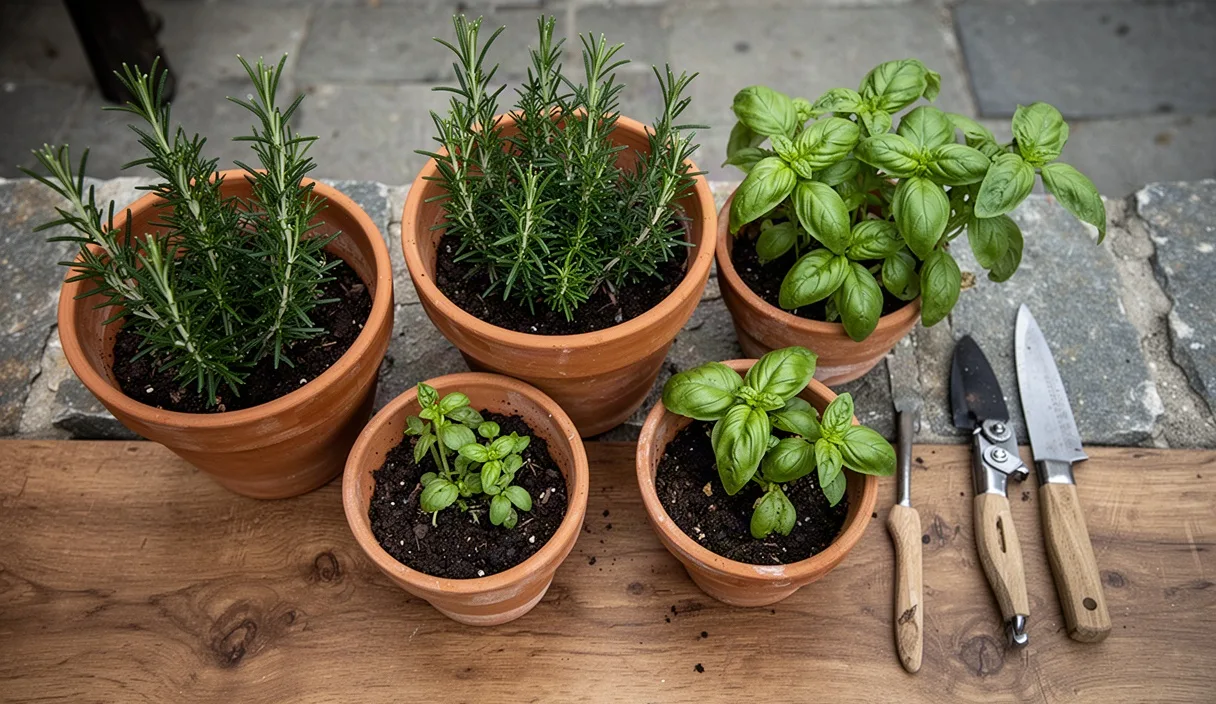
- Woody Mediterranean herbs need porous terracotta and sharp drainage to prevent root rot.
- Broadleaf annual herbs like sweet basil require deeper pots and consistent substrate dampness.
- Grouping herbs by hydrological preference prevents common overwatering failures.
The cultivation of culinary herbs within the confines of containers offers the cook an immediate harvest of fresh aromatics, yet it presents distinct horticultural challenges. Unlike garden beds where roots may travel downward and outward to find an equilibrium of moisture and air, a pot sets an unyielding boundary. Within this perimeter, the gardener controls every variable, from air porosity to hydrological cycles. Success rests largely on recognizing that herbs do not share uniform biology, and their domestic survival depends upon matching the physical volume of the vessel to the specific metabolic demands of the plant.
When containerized herbs fail, the cause is rarely an absence of warmth or sunlight. More often, it is an imbalance within the root zone, brought about by either saturated conditions that suffocate fragile root hairs or insufficient root volume that causes rapid desiccation during warm afternoons. By considering the native environments of these species, we can construct appropriate potting substrates, select containers of correct dimension, and institute deliberate watering practices that sustain vigorous, fragrant growth through several seasons.
Dividing Herbs by Transpiration and Moisture Needs
To cultivate culinary herbs effectively, one must separate them into distinct physiological categories based on their native habitats and transpiration rates. Plants native to the dry, stony slopes of the Mediterranean basin have evolved specific anatomical mechanisms to conserve water. Their leaves are often reduced in surface area, covered in protective hairs, or shielded by a thick waxy cuticle. Because their natural transpiration rate is low, their root systems are adapted to lean soils that drain within minutes of rainfall. When these plants are forced to sit in moist, heavy soil, the cells within the root tissue drown rapidly from oxygen deprivation.
In contrast, mesic herbs originate in river valleys, forest clearings, or meadows where moisture remains consistently available in the upper soil layers. These plants feature broad, comparatively thin foliage that transpires water rapidly under direct sunlight. Their cell structure depends upon positive turgor pressure; a brief period of dry substrate will cause immediate wilting, leaf drop, and premature flowering. Placing these two divergent botanical groups into the same container or using identical potting mixtures inevitably results in the decline of one or both.
| Botanical Group | Representative Species | Foliage Characteristics | Water Table Preference |
|---|---|---|---|
| Mediterranean Xerophytic | Rosemary, Common Thyme, Winter Savory, Sage, Oregano | Narrow, leathery, or pubescent leaves with dense essential oils | Requires pronounced drying intervals; intolerant of standing water |
| Mesic and Alluvial | Sweet Basil, Cilantro, Flat-Leaf Parsley, Chervil, French Tarragon | Broad, tender leaves with high stomatal conductance | Even, moderate moisture; intolerant of prolonged root desiccation |
| Stoloniferous and Riparian | Spearmint, Peppermint, Chives, Watercress | Shallow, fibrous, creeping root systems or bulbous crowns | High moisture retention; tolerates damp, cool soil conditions |
Careful grouping according to these classifications allows you to position your pots on the terrace or balcony with purpose. Mediterranean species thrive in porous terra cotta placed in high wind and maximum sunlight, while tender mesic varieties demand partial wind protection to slow down their water loss during peak midday hours.
Substrate Formulations for Mediterranean Versus Mesic Plants
Standard commercial potting mixes are designed as general-purpose media, often leaning toward high water retention through fine peat moss or processed wood fiber. While suitable for ornamental annuals, such media prove disastrous for woody Mediterranean herbs. To achieve the necessary air-filled porosity, the gardener must adjust the physical proportions of the mix before planting. Air porosity refers to the percentage of pore space filled with air after the substrate has been saturated and allowed to drain completely by gravity.
For Mediterranean herbs, the target air porosity should approach 35 percent. This is achieved by blending fine organic matter with substantial volumes of coarse inorganic aggregates. A reliable formulation comprises three parts high-quality potting compost, two parts washed pumice or horticultural perlite of 4-millimeter grade, and one part coarse silica grit. The inorganic fraction does not break down over time, ensuring that the lower half of the pot does not compact into an anaerobic sludge. The inclusion of grit adds physical ballast, which stabilizes tall, top-heavy plants like mature rosemary against strong patio winds.
Mesic and moisture-loving herbs require a substrate that balances steady capillary retention with adequate oxygenation. Their target air porosity sits closer to 20 percent. An effective medium may be produced by combining four parts screened sphagnum peat or washed coconut coir, three parts matured leaf mold or composted pine bark, and two parts coarse perlite. The coconut coir holds hydration without collapsing into tight layers, while the leaf mold supplies a mild, steady release of micro-nutrients as it decomposes, supporting rapid foliar growth without burning delicate feeder roots.
Container Volume Selection for Long-Term Root Health
The choice of container volume dictates the thermal stability and hydrological buffer of the root system. Small containers, particularly those under 15 centimeters in internal diameter, heat up rapidly in full sun, exposing roots to temperatures that inhibit nutrient uptake and accelerate evaporation. Furthermore, every container contains a physical phenomenon known as a perched water table, a layer of completely saturated soil at the bottom of the pot held by capillary force, regardless of whether drainage holes are open. In very shallow pots, this saturated layer occupies a disproportionate height of the total soil column, leaving little aerated space for healthy roots.
Mediterranean herbs possess extensive, wide-spreading root structures in nature, yet under cultivation, they can tolerate moderate confinement provided the depth permits adequate drainage away from the crown. A mature rosemary bush requires a vessel of at least 30 centimeters depth and roughly 15 liters of volume to survive through multiple years without becoming severely root-bound. Thyme and oregano, having shallower and more fibrous networks, perform admirably in wide, bowl-shaped pots of 20 centimeters depth, which allows their trailing stems to contact the soil surface and produce supplemental root nodes.
Mesic herbs with taproots, such as parsley and cilantro, require vertical clearance above all else. Parsley sends down a deep, fleshy anchor root during its first season; restricting this root in a shallow dish causes premature leaf senescence and early bolting. Provide parsley with a long pot that offers at least 25 centimeters of vertical depth, accommodating roughly 8 liters of substrate per plant. For rampant growers such as spearmint or peppermint, container volume must be treated as a barrier rather than a nursery. Mint produces aggressive subterranean rhizomes that will circle any container within months. A wide container of 20 liters, planted with a single runner, will yield abundant foliage for a full season before requiring root division in the following spring.
Watering Diagnostic Checks for Container Herbs
Scheduled watering based solely on days of the week is among the most frequent causes of plant mortality in container gardening. Ambient temperature, wind velocity, humidity, and the progressive growth of the root ball alter water consumption daily. Rather than following a rigid calendar, the grower should employ systematic diagnostic tests before introducing water to the system.
The Subsurface Resistance Check
The color and texture of the surface soil provide misleading data, as the top centimeter dries rapidly from exposure to air currents while the middle zone remains wet. Insert a clean finger or a narrow wooden dowel smoothly into the pot to a depth of 5 centimeters. If the wood emerges with dark particles adhering to its surface and feels cool against the skin, capillary water remains abundant; no irrigation is warranted. If the dowel withdraws completely clean and dry, the moisture front has retreated into the lower third of the pot, signaling that mesic herbs require prompt hydration.
Mass and Gravimetric Assessment
The most precise diagnostic tool available to the container gardener is the perceived weight of the vessel. Water weighs one kilogram per liter. A 10-liter container saturated to field capacity weighs considerably more than the same container when dry. Lift the edge of the pot several centimeters from the saucer each morning. With brief practice, your hands will register the distinct buoyancy of a dry pot versus the dense inertia of one holding moisture. This test is non-destructive, disturbs no fine roots, and provides immediate data across the entire depth of the root ball.
Physiological Observation
Careful observation of the foliage reveals early water deficits before structural damage occurs. In mesic herbs such as basil, the first sign of water stress is a subtle loss of luster on the upper leaf surface, followed by a limp posture of the youngest shoot tips. Water applied at this initial loss of turgor restores the plant within an hour without leaf drop. Mediterranean species display distress differently: leaves may turn a dull, grayish green and curl inward along their longitudinal axis to protect their stomata. If lower leaves turn yellow and drop while the soil remains moist to the touch, the roots are failing from lack of oxygen, not lack of water.
When applying water, do so methodically until liquid drains freely from the bottom apertures. This ensures that the entire soil column is moistened and prevents the accumulation of mineral salts from tap water or fertilizer. After thirty minutes, empty the saucer beneath the pot completely. Permitting a container to rest in stagnant runoff reintroduces water into the base via capillary rise, turning the perched water table into an anoxic dead zone that rapidly rots root tips.
Pruning Protocols to Delay Flowering and Encourage Bushing
Left unmanaged, culinary herbs naturally progress toward their primary botanical goal: the production of flowers and seeds. As floral induction begins, vegetative growth halts, foliage production decreases, and the concentration of volatile oils shifts. In many species, notably sweet basil and cilantro, the leaves turn bitter, tough, and pale once the flower buds emerge. Timely and correct pruning suppresses apical dominance, compelling dormant lateral buds to produce succulent culinary shoots.
- Removal of Terminal Meristems on Soft-Stemmed Herbs: On young basil, cilantro, and mint plants, locate the central growing tip once the plant exhibits three distinct sets of true leaves. Using sharp, sanitized shears or clean fingernails, excise the central stem directly above the second leaf pair. This disrupts the downward flow of the plant hormone auxin, which previously suppressed the growth of axillary buds. Within days, two vigorous new branches will emerge from the junction of the leaves below the cut, effectively doubling the density of the canopy.
- Canopy Shearing for Cushion-Forming Species: Thyme, winter savory, and oregano do not respond well to selective single-stem pinching. Instead, trim the outer canopy uniformly by one-third in late spring using sharp kitchen shears, just as the first signs of vigorous growth appear. Avoid cutting back into the old, woody base of the branches where no foliage remains, as Mediterranean shrubs often fail to push new buds from old, lignified tissue. This broad shearing encourages a dense, domed habit that shields the crown from direct sun and reduces soil evaporation.
- De-heading and Renovation of Rapid-Bolting Species: Cilantro and chervil react strongly to rising ambient temperatures and lengthening days by sending up thin, tall flower stalks. Check the center of the rosette weekly. If an elongated, ribbed stem begins to push upward, sever it as close to the base as possible. If the plant has already formed its lace-like flower heads, the vegetative harvest has largely concluded; at this stage, it is best to sow a fresh sequence of seeds in a separate small container to maintain a perpetual supply.
- Hard Pruning of Stoloniferous Mints: By midsummer, potted mint often becomes leggy, losing its lower foliage and expending energy on pale lilac flower spikes. At this point, harvest the entire plant by cutting all stems back to approximately 4 centimeters above the soil line. Follow this harvest with a thorough soaking of diluted balanced liquid fertilizer. The extensive root system will rapidly generate an entirely new flush of tender, aromatic stems, providing a pristine second harvest before autumn.
Common Mistakes in Herb Container Culture
Even conscientious gardeners encounter difficulties when subtle errors compound within the confined ecology of a container. Awareness of these common oversights preserves both the plant and the structural qualities of the substrate.
- Combining Disparate Species in a Single Planter: Planting rosemary, thyme, and sweet basil together in a shared trough creates an insoluble conflict. The moisture levels required to keep the basil turgid will inevitably rot the roots of the thyme, whereas restricting water to satisfy the thyme will cause the basil to wither and drop its foliage.
- Overpotting Immature Plugs: Placing a tiny seedling directly into a massive 20-liter tub often leads to waterlogging. The small root system cannot absorb the large volume of water held by the surrounding soil, leaving the perimeter damp and cold for weeks. This stagnant moisture encourages fungal pathogens such as Pythium and Rhizoctonia. Scale pot sizes upward gradually as root networks expand.
- Leaving Pots in Standing Runoff: Allowing drainage saucers to remain filled with water creates a permanent anaerobic layer at the base of the pot. Feeder roots within that zone die within forty-eight hours, impairing the plant's capacity to absorb both moisture and nutrients.
- Using Garden Topsoil in Closed Vessels: Digging soil directly from garden beds and placing it into a pot destroys its natural crumb structure. Confined by container walls, field soil packs down into a dense, cement-like block that severely limits drainage and excludes atmospheric air.
- Hesitant, Shallow Sprinkling: Applying small splashes of water to the soil surface moistens only the top two centimeters, encouraging roots to grow upward toward the heat instead of expanding downward into the cooler, protective lower regions of the pot.
Practical Next Steps for the Container Gardener
To establish a resilient collection of culinary herbs, begin by auditing your current vessels and plant arrangements. Inspect the base of every container to confirm that drainage holes are clear and unobstructed by debris. Where drainage apertures are absent, drill new openings or relegate those decorative vessels to serve merely as outer covers (cachepots) that house a draining interior pot.
Separate your culinary collection into two distinct zones on your balcony or patio: one dedicated to full-sun, lean-soil Mediterranean specimens, and the other to sheltered, rich-soil mesic varieties. If any plants are currently languishing in dense field soil or exhibiting root compaction, prepare the inorganic-amended substrate formulations detailed above and pot them on during a cool, overcast morning. Establish the morning habit of lifting your containers to register their weight, allowing this physical assessment, rather than a calendar, to guide your watering decisions. When dealing with persistent fungal root rot, severe pest infestations, or unresolvable nutritional chlorosis, do not hesitate to consult a certified regional horticulturist or university extension agent for localized diagnostic guidance.
This material serves educational purposes only; consult a local certified extension specialist or soil testing laboratory for site-specific agricultural decisions. Disclaimer

Further Reading
-
 Kitchen Greens and Balcony Culture 8 min read
Growing Crisp Salad Greens on Balcony Shelving
You will design a multi-tiered balcony growing station capable of producing reliable yields of cut-and-come-again greens through three seasons. You will maintain soil moisture and avoid early bolting during warmer weather periods.